
Double Service Is The Best Argument Generator We Have Ever Reviewed
We recorded fourteen genuine disagreements in a single four-hour evening, and every one of them was the design working exactly as intended. This is what a kitchen game gets right when every mistake is visible on screen at the moment it happens.
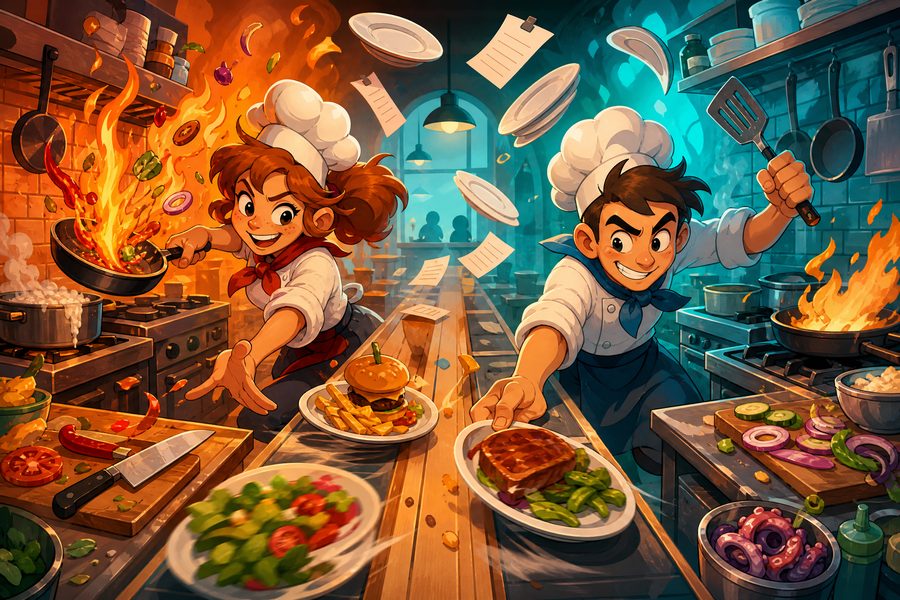
There is a specific kind of failure in cooperative games where something goes wrong, both players are certain it was the other one, and neither can prove it. That is not a difficulty problem, it is an information problem, and it is what turns a pleasant evening into a sulk. Double Service solves it by refusing to hide anything: both stations are on screen at all times, every timer is visible to both players, and every dropped plate has an unambiguous author.
The result is that the fourteen arguments we logged were all productive. Somebody was demonstrably wrong each time, they could see it, and the round continued. We have played co-op kitchen games where the same number of disputes ended the session; here they became the texture of the game.
What the split screen costs
Almost nothing, and that is unusual enough to detail. The kitchen is designed to fit in a half-width frame: the layout is horizontal, the ticket rail sits along the top of the shared area rather than in a corner of each half, and order text is rendered at a size that stays readable. We checked from two and a half metres, which is a realistic sofa distance, and every element was legible.
| Element | Full screen | Split screen | Readable from sofa |
|---|---|---|---|
| Order tickets | Top centre | Top centre, shared | Yes |
| Ingredient labels | On station | On station, same size | Yes |
| Timers | Above pans | Above pans, unchanged | Yes |
| Score counter | Corner | Shared, centre bottom | Yes |
| Tutorial prompts | Lower third | Lower third, smaller | Marginal |
The tutorial prompts are the only element that shrinks awkwardly, and they appear for roughly the first thirty minutes. It is worth having the more experienced player read them aloud, which is a small thing to have to do and the only accommodation the game asks for.
The skill gap test
Every game here gets a session with one confident player and one who does not play much, because that is the actual living room rather than the imagined one. Double Service handles it better than anything else on this site, and it does so through work allocation rather than through assists.
Because the kitchen has jobs of wildly different complexity — chopping is simple and plating under time pressure is not — two players naturally sort themselves into roles that match their comfort. Nothing in the game suggests this or enforces it. It emerges because the tasks are genuinely different, and it means the less confident player is contributing rather than being carried.
What we counted
| Session | Pairing | Rounds played | Disputes logged |
|---|---|---|---|
| Evening one | Two experienced | 31 | 14 |
| Evening two | Mismatched | 26 | 6 |
| Evening three | Mismatched, roles swapped | 24 | 9 |
| Evening four | Two experienced, hard mode | 18 | 19 |
Note that the mismatched pairing produced fewer disputes rather than more. In most co-op games the opposite happens, because the weaker player makes mistakes they cannot diagnose. Here the division of labour means each player is failing at their own job in a way both can see.
Where it falls short
Two things. First, progress saves against player one's profile only. If the second player wants their own record of what was unlocked, they cannot have one, and on a shared machine this genuinely matters. Second, the late levels introduce a moving-floor mechanic that makes precise positioning much harder, and it disproportionately punishes the less confident player. We would skip the last four levels and lose nothing.
There is also no way to pause during a round, which sounds trivial and is not when you are playing in an evening with other people in the house. A round is four minutes long, so this is survivable, but a game built for shared living rooms should understand that living rooms have doorbells.
Shared-play verdict
The best couch cooperative game we have reviewed, and it earns that by solving the information problem rather than the difficulty problem. Both stations always visible, one copy and one machine, split-screen text that survives a real sofa distance, and a task structure that lets a mismatched pair sort itself out without any patronising assists.
Buy it if you have one machine, two controllers and anybody at all to play with. Be aware that saves belong to player one, there is no mid-round pause, and the final four levels punish the weaker player unnecessarily.
How we test with mismatched pairs is explained on the about page, and the copies-and-saves criteria are on the scoring page.