
Relay Works Cannot Be Played Alone, And It Is Better For Refusing To Try
Forty-eight rooms, each of which shows half its information to one player and half to the other. There is no solo mode, no artificial-partner option and no way to see both halves at once, so the entire game becomes an exercise in describing things clearly.
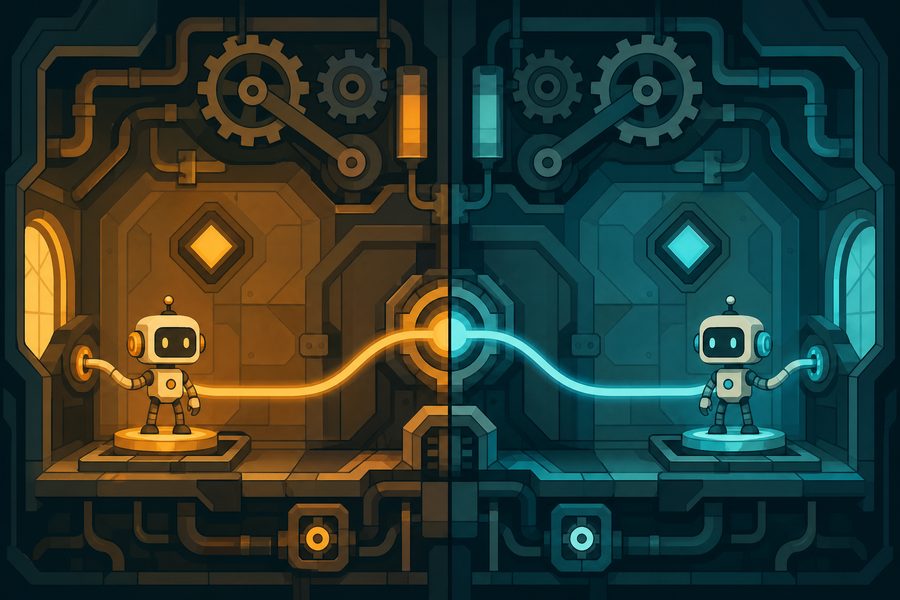
Most cooperative puzzle games are single-player puzzles that happen to need two pairs of hands. Relay Works is something rarer: a puzzle game about language. Each room presents a symmetrical machine hall, one half to each player on a split screen, and the halves differ in ways neither player can see directly. Solving a room means one of you describing what you see accurately enough that the other can act on it.
The consequence is that difficulty scales with vocabulary rather than with dexterity. Our fastest solves came in rooms where we happened to have agreed on names for things — we spent seventeen hours developing a private terminology for valve shapes and it was the most enjoyable part of the whole game. Our slowest solve, 41 minutes on room 33, was almost entirely caused by both of us using the word "left" to mean different things.
The split screen, and why it must be one
Relay Works could have been an online game with each player on their own machine, and it would have been a worse one. The comedy and the frustration both come from being able to hear the other person's tone, see them gesture at their half of the screen, and realise simultaneously that you have been describing two different objects for four minutes. Playing this at a distance would flatten it.
The technical execution supports that. Both halves render at full detail, the interface within each half is scaled properly rather than merely shrunk, and there is a deliberate black divider that makes it socially awkward to glance across. Looking at your partner's half is possible, of course, and the game cannot stop you. It simply makes it feel like cheating, which is enough.
| Room block | Rooms | Median solve | Longest solve |
|---|---|---|---|
| Introduction | 1–12 | 4 min | 9 min |
| Shapes and names | 13–24 | 11 min | 26 min |
| Timing added | 25–36 | 19 min | 41 min |
| Both halves changing | 37–48 | 24 min | 38 min |
The skill gap test
This is the game's most interesting result. In our mismatched session, the less experienced player was not disadvantaged at all, because nothing in Relay Works requires reflexes, aim or familiarity with game conventions. What it requires is careful description, and that is not a gaming skill. Our inexperienced tester was noticeably better at it than the experienced one, which was humbling and instructive.
We would go further: this is the game on this site we would recommend most confidently to a pair where one person does not play games at all. The only barrier is basic movement control, which the first twelve rooms teach patiently and without pressure.
Where it goes wrong
Rooms 25 to 36 introduce timing pressure, and it is a mistake. The core loop — describe, understand, act — is deliberative, and adding a countdown converts thoughtful conversation into hurried shouting. Three of those twelve rooms we solved by accident under time pressure rather than by understanding, which means the game briefly stopped teaching us anything.
There is also no hint system of any kind, and in a game with no external solution to look up, a pair genuinely stuck on room 33 has nowhere to go. We were stuck for 41 minutes and enjoyed most of it, but a less patient pair would simply stop playing and never come back. A single nudge option would cost nothing.
Practical notes
One copy and one machine covers both players. Progress is stored per room rather than per profile, so either player can resume with a different partner without losing anything, which is the correct way to handle it and is rarer than it should be. Rooms can be revisited freely, and the game keeps no record of how long you took, which we appreciated more than we expected.
Shared-play verdict
A cooperative puzzle game that genuinely could not exist as a single-player experience, built around describing things to another person rather than executing anything. The split screen is properly designed, progress is stored sensibly, and the difficulty rests on communication rather than skill, which makes it the fairest game here for a mismatched pair.
Buy it if you want something to play with a partner who does not play games. Be aware that the twelve timed rooms in the middle work against the design, and that there is no hint of any kind when you are stuck.
Our approach to mismatched testing is described on the about page. What we mean by a fair skill gap is set out on the scoring page.